THE MOB MUSEUM TO UNVEIL BUGSY SIEGEL’S NEVER-BEFORE-SEEN PERSONAL EFFECTS FROM CRIME SCENE IN NEW EXHIBIT EXAMINING HIS UNSOLVED MURDER
LAS VEGAS, Oct. 28, 2026
Press Release Disclaimer: This is a press release distributed through the XPR Media network. It has not been independently verified by our newsroom.

THE MOB MUSEUM TO UNVEIL BUGSY SIEGEL’S NEVER-BEFORE-SEEN PERSONAL EFFECTS FROM CRIME SCENE IN NEW EXHIBIT EXAMINING HIS UNSOLVED MURDER
PR Newswire
LAS VEGAS, Oct. 28, 2026
Exhibit Exploring One of America’s Most Tantalizing Cold Cases to Open Nearly 80 Years Following Mobster’s Demise
For downloadable photos, click here
LAS VEGAS, Oct. 28, 2026 /PRNewswire/ — The Mob Museum, the National Museum of Organized Crime and Law Enforcement, announces “What Bugsy Left Behind,” a new exhibit examining the still-unsolved murder of one of the most notorious crime figures in American history: mobster Benjamin “Bugsy” Siegel. Opening Friday, Nov. 13, a never-before-seen collection of Siegel’s personal effects, held by the Beverly Hills Police Department as evidence for nearly 80 years, will offer an intimate glimpse into Siegel’s final day.
The exhibit will explore the competing theories surrounding his murder while tracing his influence on organized crime in Southern California and the development of midcentury Las Vegas. Its debut coincides with two major milestones in that history: the Flamingo Hotel’s 80th anniversary on Dec. 26, 2026, and the approaching 80th anniversary of Siegel’s murder.
On June 20, 1947, Siegel was shot and killed at the Beverly Hills home of his girlfriend, Virginia Hill, while she was traveling in Europe. The 41-year-old mobster had traveled from Las Vegas to Southern California to reunite with his two daughters for a planned vacation, but he was killed before they could see him. As one of the Beverly Hills Police Department’s oldest cold cases, his murder remains unsolved nearly eight decades later, with historians continuing to debate who was responsible and why.
Among the leading theories explored in the new exhibit is that Charles “Lucky” Luciano and other powerful Mob figures ordered Siegel’s killing over his handling of the Flamingo Hotel, where lavish spending, disappointing early returns and suspicions of skimming had reportedly angered his underworld investors. Another theory suggests Siegel was targeted by a rival seeking control of the lucrative race wire, which supplied horse-racing results to bookmaking operations across California, Arizona and Nevada. A third theory points to one of Hill’s brothers, who may have sought revenge for Siegel’s abusive treatment of his sister.
Siegel was shot while reading an early edition of the Los Angeles Times. Personal effects found on his person and featured in the exhibit include:
- Meyer Lansky’s business card: A business card identifying Siegel’s longtime friend and criminal associate as a Wurlitzer phonograph distributor in New York, reflecting Lansky’s involvement in legitimate, cash-based businesses that offered opportunities to conceal illicit activities.
- Photograph of Virginia Hill: A wallet-sized photograph of Siegel’s on-again, off-again girlfriend bearing the handwritten message, “Sweetheart Benny I love you Pup,” on the back.
- Nevada certificate of vehicle ownership: Issued less than two months before Siegel’s death, the document identifies him as the owner of a 1946 Chrysler Windsor convertible coupe and lists the Flamingo Hotel as his address.
- Social Security card: Siegel’s Social Security card lists the Flamingo Hotel as his address and identifies him by his preferred name, “Ben Siegel.”
- Jack’s at the Beach advertisement: A promotional item from the Santa Monica restaurant Siegel visited with several companions, including Hill’s brother Charles “Chick” Hill, just hours before his murder.
- Photographs of Siegel’s daughters: Personal photographs of Barbara and Millicent Siegel, including childhood portraits with affectionate handwritten messages and a photograph of the sisters as teenagers shortly before their father’s death.
- 1947 American Red Cross membership card: A certificate documenting Siegel’s $500 donation to the American National Red Cross in Las Vegas.
- Automobile Club of Southern California membership card: Siegel’s automobile association membership card, which lists the Flamingo Hotel as his address.
- Handwritten address note: A note containing information about the house where Siegel was killed. Hill rented the home at 810 North Linden Drive from her friend and former Hollywood agent Juan Romero.
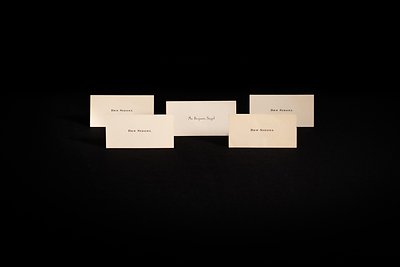
- Personal calling cards: Printed cards bearing the names “Ben Siegel” and “Mr. Benjamin Siegel,” reflecting the social customs of the era.
- The Dixie Shops business card: A business card bearing Siegel’s name, for the national chain of women’s apparel stores. It’s unknown why Siegel would have had a business card for this store, but mobsters often used legal businesses to appear legitimate.
- Yellow Cab Company receipt: A faded receipt for a 50-cent taxi fare in Los Angeles from January 1947, when Siegel frequently traveled between Southern California and Las Vegas.
“For decades, these belongings were preserved as evidence in an unsolved murder investigation,” said Geoff Schumacher, Vice President of Research, Collections and Programs, The Mob Museum. “Now, they’ll serve an entirely different purpose by helping us educate the public about one of organized crime‘s most notorious figures. It’s a rare opportunity to connect a compelling criminal case with the broader history of how organized crime operated and shaped American society.”
The collection’s public debut follows a decades-long effort to recover Siegel’s personal belongings from police custody. Following his death at age 41, the Beverly Hills Police Department retained the items as evidence in its investigation. In 2025, Siegel’s granddaughter Wendy Rosen filed a lawsuit seeking their return to the family. Following the judge-ordered release, The Mob Museum acquired the collection from Rosen.
Born in Brooklyn, New York, in 1906, Siegel rose through the ranks of organized crime during Prohibition, joining forces with Lansky in bootlegging and other illegal enterprises. In the mid-1930s, he moved to Los Angeles, where he helped expand criminal rackets throughout Southern California’s rapidly growing communities while cultivating relationships with Hollywood figures, including actor George Raft. His growing influence eventually extended into Las Vegas, where he seized control of the race wire, purchased El Cortez Hotel & Casino and then became involved in the development of the Flamingo Hotel.
For more information on The Mob Museum or to purchase tickets, visit themobmuseum.org.
ABOUT THE MOB MUSEUM
The Mob Museum, the National Museum of Organized Crime and Law Enforcement, a 501(c)3 non-profit organization, provides a world-class journey through true stories—from the birth of the Mob to today’s headlines. Housed in the actual 1933 federal courthouse where mob hearings shook the nation, The Mob Museum is one of the highest-rated attractions and best things to do in Las Vegas, and unlike anything else in the city. With four immersive floors, The Mob Museum offers a provocative, contemporary look at these topics through hundreds of artifacts and immersive storylines. Guests can test their instincts in a live simulation and make the split-second decisions law enforcement face every day or step inside the Crime Lab and learn how forensic scientists, fingerprint analysts and DNA profilers build a case from evidence. Seeing more than 400,000 visitors annually, and more than 5 million since opening, The Mob Museum has accumulated numerous accolades, including being named one of Tripadvisor’s “Top 25 U.S. Museums;” one of U.S. News & World Report’s “Best Museums in the U.S.,” “Top Five Best History Museums in the United States” and one of its “12 Can’t Miss U.S. Museum Exhibits;” named “A Must for Travelers” by The New York Times and one of “20 Places Every American Should See” by FOX News. The Museum is a two-time winner of the Mayor’s Urban Design Award for Historic Preservation and Adaptive Reuse and is accredited by the American Alliance of Museums. The Museum is open daily; visit themobmuseum.org for admission rates, operating hours and parking information. For more information, call (702) 229-2734 or visit themobmuseum.org.
SOCIAL MEDIA LINKS:
www.Facebook.com/themobmuseum
www.Twitter.com/themobmuseum
www.Instagram.com/themobmuseum
www.Tiktok.com/@themobmuseum
 View original content to download multimedia:https://www.prnewswire.com/news-releases/the-mob-museum-to-unveil-bugsy-siegels-never-before-seen-personal-effects-from-crime-scene-in-new-exhibit-examining-his-unsolved-murder-302922643.html
SOURCE The Mob Museum