
Comprehensive Smart Cities Market Report Covers Forecasts, Innovations And Industry Outlook
The Business Research Company’s Smart Cities Global Market Report 2026 – Market Size, Trends, And Forecast 2026-2035
Press Release Disclaimer: This is a press release distributed through the XPR Media network. It has not been independently verified by our newsroom.

The Business Research Company’s Smart Cities Global Market Report 2026 – Market Size, Trends, And Forecast 2026-2035
LONDON, GREATER LONDON, UNITED KINGDOM, October 28, 2026 /EINPresswire.com/ — The smart cities market is rapidly evolving, driven by advancements in technology and increased urbanization. As cities become more connected and sustainable, the demand for intelligent infrastructure solutions grows. This overview explores the market’s size, major players, key growth drivers, innovative trends, and regional developments shaping the future of smart urban environments.
Projected Market Growth and Size in the Smart Cities Market
The smart cities market is expected to exceed $2,210 billion by 2030, expanding at a compound annual growth rate (CAGR) of 19%. This growth is powered by the widespread adoption of smart homes, smart grids, and environmentally friendly buildings. Key players in the global technology and urban infrastructure sectors focus on intelligent transportation systems, smart energy management, connected public infrastructure, and Internet of Things (IoT) platforms. Central to their strategies are digital transformation efforts, sustainability initiatives, and the integration of AI, cloud computing, and data analytics.
Request A Free Sample Of The Smart Cities Market Report
https://thebusinessresearchcompany.com/sample_request?id=6060&type=smp&name=Smart%20Cities%20Market%20Report%202026&utm_source=EINPresswire&utm_medium=Paid&utm_campaign=Oct_PR
Fragmentation and Market Share Among Leading Smart Cities Companies
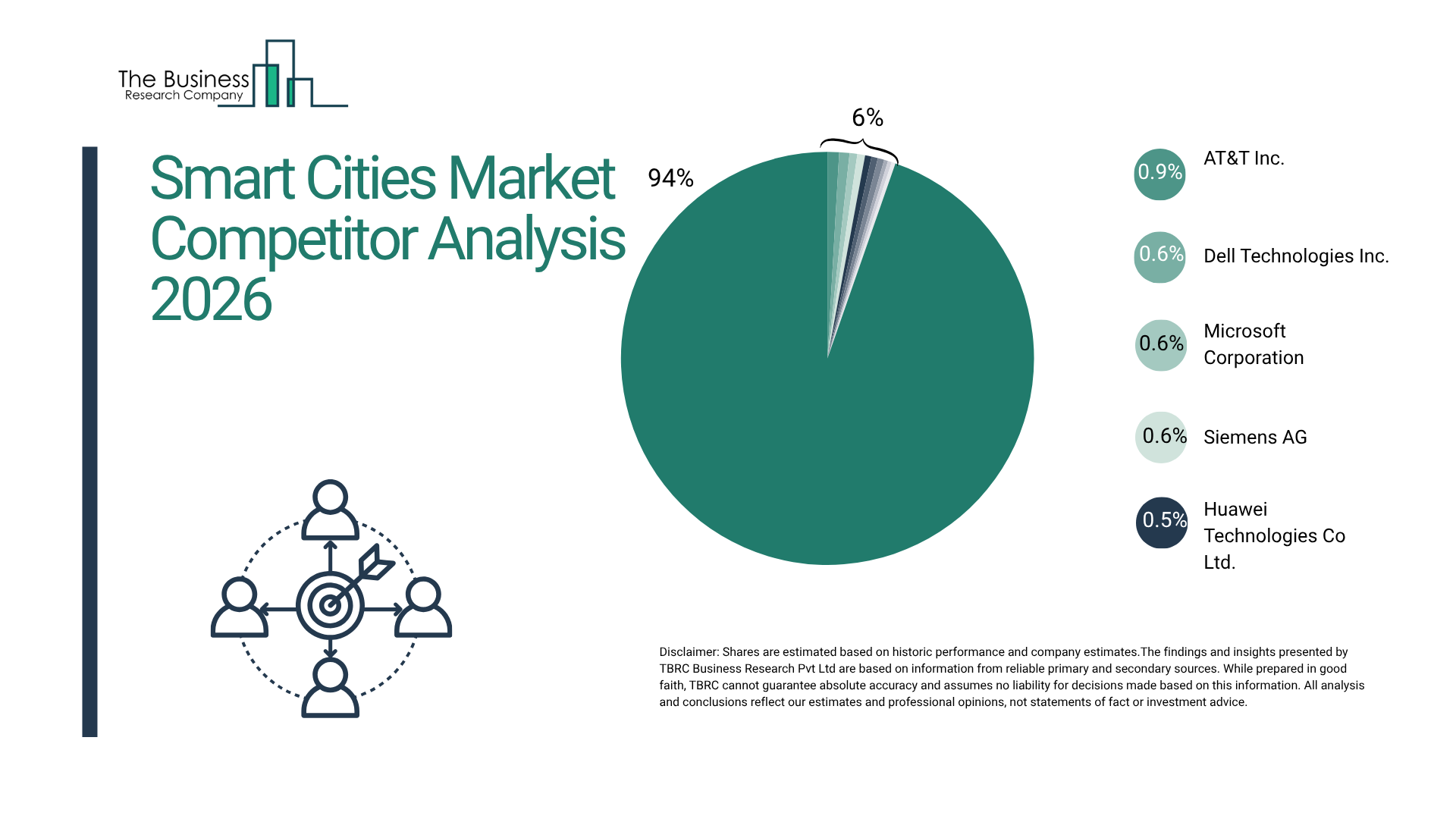
The smart cities market remains highly fragmented, with the top 10 companies accounting for only 6% of total revenue in 2025. This low concentration highlights the relatively easy market entry across various solution areas, influenced by fast technological innovation, changing regulations, the need for interoperability, and growing demand for scalable, secure urban infrastructure. Leading corporations maintain their foothold through extensive product portfolios, strong government and enterprise partnerships, global service operations, and continuous innovation. As demand increases for connected utilities, intelligent transportation, smart energy, and IoT-enabled public safety, collaborations and regional expansion will be key to strengthening market positions.
Key Players and Their Market Share in 2025
The foremost companies by market revenue share in 2025 include:
– AT&T Inc.: 1%
– Dell Technologies Inc.: 1%
– Microsoft Corporation: 1%
– Siemens AG: 1%
– Huawei Technologies Co Ltd.: 1%
– Cisco Systems Inc.: 1%
– General Electric Company: 1%
– Telefonaktiebolaget LM Ericsson: 0.5%
– International Business Machines (IBM) Corporation: 0.3%
– ABB Ltd.: 0.3%
Access The Detailed Smart Cities Market Report Here
https://thebusinessresearchcompany.com/report/smart-cities-global-market-report?utm_source=EINPresswire&utm_medium=Paid&utm_campaign=Oct_PR
Strategies Employed by Leading Smart Cities Providers
Top companies compete by developing integrated digital urban infrastructure that enhances city operations and services. They leverage IoT technologies for better resource management and service delivery, expand smart infrastructure to support urban growth and digital transformation, and embed AI to improve automation and decision-making processes within smart cities.
AT&T’s Dominance in the Diverse Smart Cities Industry
According to The Business Research Company, AT&T Inc. led global smart cities sales in 2025, capturing a 1% market share. Its business solutions division actively participates in the sector by offering IoT connectivity, edge computing, network technologies, and data management platforms that support intelligent transportation, public safety, energy management, and connected urban applications.
Major Companies Shaping the Smart Cities Market
The market includes a broad range of key players such as AT&T Inc., Dell Technologies Inc., Microsoft Corporation, Siemens AG, Huawei Technologies Co. Ltd., Cisco Systems Inc., General Electric Company, Telefonaktiebolaget LM Ericsson, IBM Corporation, ABB Ltd., SAP SE, Emerson Electric Co., Intel Corporation, Schneider Electric SE, Oracle Corporation, Fujitsu Limited, Capgemini SE, NEC Corporation, Robert Bosch GmbH, Infosys Limited, Accenture plc, Hitachi Ltd., Nokia Corporation, Cubic Corporation, Koninklijke Philips N.V., Cognizant Technology Solutions Corporation, Honeywell International Inc., HID Global Corporation, Itron, Inc., Vix Technology Ltd., Scheidt & Bachmann GmbH, and Confidex Ltd.
Market Size Outlook and Share of Smart Technology Sector
By 2030, the smart cities market is forecast to surpass $2,210 billion, while the broader Smart Technology sector is expected to reach around $3,634 billion. Smart cities will represent about 61% of this sector. Within the larger Information Technology industry, which is projected to be worth $13,788 billion by 2030, smart cities will comprise nearly 16% of the total market. The overall growth rate for smart cities is anticipated at a CAGR of 19% through 2030.
Solutions Segment Dominates Smart Cities Market Spending
When looking at components, the market is divided into solutions and services, with solutions making up the largest share. In 2030, solutions are expected to account for 68% of total smart cities spending, equating to $1,510 billion. The solutions segment includes intelligent platforms for real-time urban management, smart buildings with automated facility oversight, integrated command centers, IoT-based city monitoring, predictive analytics for planning and resource allocation, along with continuous innovation in connected infrastructure technologies.
Breakdown of Smart Cities Market by Type and Application
The market segments by type cover roadways, railways, and airways. By application, it includes smart governance, smart buildings, smart utilities, smart transportation, smart healthcare, and other related uses.
Asia-Pacific to Lead in Smart Cities Market Revenue Generation
The Asia-Pacific region is projected to hold the largest portion of the smart cities market in 2030, reaching a value of $1,208 billion, up sharply from $449 billion in 2025. This remarkable growth, at a CAGR of 22%, is fueled by rapid urban population expansion, development of connected transport and smart infrastructure projects, smart energy and water systems, rollout of 5G and edge computing, investments in digital governance, public services, and sustainable urban development across countries like China, India, Japan, South Korea, and Southeast Asia.
China’s Leading Role in the Smart Cities Market by 2030
China is expected to be the largest single-country market within smart cities, valued at $546 billion in 2030, rising from $209 billion in 2025 with a growth rate of 21% CAGR. This growth is driven by extensive government-led smart city initiatives, utilization of AI and big data for urban management, intelligent transportation and autonomous mobility projects, smart surveillance and public safety systems, digital payment platforms, citizen service innovations, and significant technology investment focused on urban development.
Smart Homes, Smart Grids, and Green Buildings as Key Market Drivers
The rapid expansion of the smart cities market through 2030 will be propelled by three major factors: a surge in smart home adoption, increased investment in energy-efficient smart grids, and growing demand for sustainable green buildings within urban ecosystems worldwide.
Widespread Adoption of Smart Homes Fuels Market Growth
Smart homes represent the most immediate growth opportunity, driven by urbanization, proliferation of IoT devices, and rising demand for automated lighting, security, and energy management systems. Integration of voice assistants and connectivity with city infrastructure is accelerating this uptake, contributing an estimated 2.0% annual growth to the market.
Energy Efficiency and Smart Grid Investments Support Market Expansion
Governments and utility providers are channeling investments into smart grids, advanced metering infrastructure, and renewable energy integration to reduce costs, enhance reliability, and support carbon reduction goals. This focus on energy efficiency is projected to add around 1.5% annual growth to the smart cities market.
Growing Interest in Sustainable and Green Buildings
There is increasing adoption of green buildings equipped with smart heating, ventilation, air conditioning (HVAC), water, and energy management systems to promote sustainability. While stricter regulations encourage uptake, high initial costs and slow retrofitting processes temper growth relative to smart grids and homes. This factor is expected to contribute about 1.3% annual market growth.
The Impact of AI-Driven Mobility on Smart Cities Development
AI-powered smart mobility solutions are transforming urban transportation networks by enhancing connectivity and efficiency. For example, in September 2025, Hyundai Motor Group launched the Next Urban Mobility Alliance (NUMA), aiming to develop AI-driven transportation systems, Autonomous Mobility-as-a-Service (MaaS), and cloud-based mobility platforms. These advancements help cities improve transport efficiency and accelerate the creation of sustainable smart urban environments.
Significant Growth Opportunities in Smart Cities Solutions and Services
The smart cities market’s combined solutions and services segments are expected to add over $1,270 billion in value by 2030. Between 2025 and 2030, solutions will grow by $813 billion, while services will expand by $457 billion. This growth is driven by the demand for integrated urban management platforms, smart governance tools, citizen engagement solutions, intelligent mobility systems, energy-efficient infrastructure, data-driven decision-making, and specialized consulting, maintenance, and integration services, all aimed at improving urban living standards and sustainability.
Overview of the Smart Cities Market Supply Chain
The supply chain for smart cities begins with raw material suppliers such as Intel Corporation, Qualcomm Incorporated, NVIDIA Corporation, NXP Semiconductors N.V., STMicroelectronics N.V., Infineon Technologies AG, Texas Instruments Incorporated, Analog Devices Inc., Microchip Technology Incorporated, Renesas Electronics Corporation, Broadcom Inc., Marvell Technology Inc., Murata Manufacturing Co. Ltd., Rohm Co. Ltd., MediaTek Inc., Skyworks Solutions Inc., Qorvo Inc., TE Connectivity Ltd., Amphenol Corporation, Belden Inc., CommScope Holding Company Inc., Corning Incorporated, Prysmian S.p.A., Nexans S.A., and Sumitomo Electric Industries Ltd.
Wholesalers and distributors include companies like Arrow Electronics Inc., Avnet Inc., Ingram Micro Holding Corporation, TD SYNNEX Corporation, WESCO International Inc., Rexel S.A., Sonepar Group, Graybar Electric Company Inc., RS Group plc, Future Electronics Inc., DigiKey Corporation, Mouser Electronics Inc., TTI Inc., Macnica Holdings Inc., Exclusive Networks S.A., ALSO Holding AG, ScanSource Inc., Redington Limited, Westcon Group Inc., Esprinet S.p.A., Bechtle AG, Cancom SE, EET Group A/S, and D&H Distributing Company.
End users of smart city products and services cover a wide range of corporations such as Cisco Systems Inc., IBM Corporation, Microsoft Corporation, Siemens AG, Schneider Electric SE, Honeywell International Inc., Huawei Technologies Co. Ltd., Hitachi Ltd., NEC Corporation, Fujitsu Limited, Oracle Corporation, SAP SE, Telefonaktiebolaget LM Ericsson, Nokia Corporation, Dell Technologies Inc., Hewlett Packard Enterprise Company, ABB Ltd., Johnson Controls International plc, Bosch Security Systems GmbH, Itron Inc., Verizon Communications Inc., AT&T Inc., Orange S.A., Vodafone Group Plc, and Capgemini SE.
The 2026 edition of our market reports now delivers enhanced analytical coverage through market attractiveness scoring and analysis, total addressable market (TAM) analysis, company scoring matrix graphics and tables, Excel-based forecasting dashboards, market hotspots infographics, key technologies and future trend analysis, plus updated graphics and tables.
Learn More About The Business Research Company
The Business Research Company (www.thebusinessresearchcompany.com) is a leading market intelligence firm renowned for its expertise in company, market, and consumer research. We have published over 30,000+ reports across 27 industries and 60+ geographies. Our research is powered by 1,500,000 datasets, extensive secondary research, and exclusive insights from interviews with industry leaders.
We provide continuous and custom research services, offering a range of specialized packages tailored to your needs, including Market Entry Research Package, Competitor Tracking Package, Supplier & Distributor Package and much more.
Disclaimer: Please note that the findings, conclusions and recommendations that TBRC Business Research Pvt Ltd delivers are based on information gathered in good faith from both primary and secondary sources, whose accuracy we are not always in a position to guarantee. As such TBRC Business Research Pvt Ltd can accept no liability whatever for actions taken based on any information that may subsequently prove to be incorrect. Analysis and findings included in TBRC reports and presentations are our estimates, opinions and are not intended as statements of fact or investment guidance.
Contact Us:
The Business Research Company
Americas +1 310-496-7795
Europe +44 7882 955267
Asia & Others +44 7882 955267 & +91 8897263534
Email: marketing@tbrc.info
Follow Us On:
LinkedIn: https://in.linkedin.com/company/the-business-research-company
Oliver Guirdham
The Business Research Company
+44 7882 955267
Visit us on social media:
LinkedIn
Facebook
X
Legal Disclaimer:
EIN Presswire provides this news content “as is” without warranty of any kind. We do not accept any responsibility or liability
for the accuracy, content, images, videos, licenses, completeness, legality, or reliability of the information contained in this
article. If you have any complaints or copyright issues related to this article, kindly contact the author above.

Media gallery
