ASEAN+3: Navigating Shocks Through Stronger Foundations and Deeper Financial Integration
SINGAPORE, Oct. 5, 2026
Press Release Disclaimer: This is a press release distributed through the XPR Media network. It has not been independently verified by our newsroom.

ASEAN+3: Navigating Shocks Through Stronger Foundations and Deeper Financial Integration
PR Newswire
SINGAPORE, Oct. 5, 2026
SINGAPORE, Oct. 5, 2026 /PRNewswire/ — AMRO today released its ASEAN+3 Financial Stability Report (AFSR) 2026 and the ASEAN+3 Regional Economic Outlook (AREO) October Update, highlighting the region’s solid performance despite the Middle East energy shock.
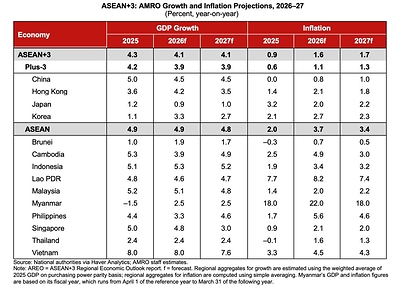
Growth is projected at 4.1 percent in both 2026 and 2027, and inflation at 1.6 and 1.7 percent, respectively. The 2026 forecasts are unchanged from July. Both 2027 forecasts are 0.1 percentage point higher: stronger AI-related exports and investment support growth, while higher energy costs and El Niño-related food-price pressures raise inflation.
Regional financial systems remain resilient amid heightened global risks
The global macro-financial environment has been shaped by optimism about artificial intelligence (AI) and geopolitical tensions from the Middle East conflict. Shipping disruptions in the Strait of Hormuz pushed up energy prices and revived global inflation concerns.
“The AI investment cycle is supporting a widening range of regional activities, although domestic demand remains uneven,” said AMRO Chief Economist Dong He. “Disruptions to energy supplies and industrial inputs proved less severe than many had feared, limiting the drag on production. However, higher energy and logistics costs continued to weigh on household purchasing power and business costs.”
Despite external headwinds and rising dollar interest rates, ASEAN+3 economies have shown resilience. Market adjustments have been orderly but reactions have varied across jurisdictions, reflecting differences in exposure to external shocks, domestic fundamentals, and policy responses. Even as global shocks continue to affect regional markets during acute stress, ASEAN+3 financial conditions have become less synchronized with the global financial cycle.
Most regional economies retain sound external positions and adequate foreign exchange reserves. The banking system remains well-capitalized, liquid, and profitable. Corporate and household debt-to-GDP ratios have generally declined, while public debt-to-GDP has broadly stabilized. Nevertheless, pockets of domestic vulnerabilities warrant continued vigilance.
Financial stability risks are becoming more interconnected
Looking ahead, the growth outlook is particularly sensitive to AI-related demand, which could strengthen or weaken exports and investment. Additional downside risks include renewed Middle East energy disruptions and a more persistent El Niño, alongside financial-market volatility and further protectionist measures.
AMRO warns that the region’s financial risks are becoming increasingly complex and interconnected. A sharp repricing of AI-related assets could trigger broader market corrections, forced deleveraging and tighter credit conditions. Abrupt US dollar movements could quickly transmit to ASEAN+3 economies through exchange rates, capital flows, asset prices, and funding costs.
While the growth of nonbank financial institutions (NBFIs) can broaden and diversify financing sources, rising leverage, liquidity mismatches, and interconnectedness with banks and financial markets can amplify stress. Digital finance presents additional challenges, including risks from foreign-currency-denominated stablecoins, cyberattacks, and digital fraud.
Stronger buffers and deeper regional integration
To mitigate these vulnerabilities, the region should maintain robust macro-financial buffers through credible policy frameworks, adequate foreign exchange reserves, and deeper local currency markets. Surveillance should adopt a system-wide perspective encompassing NBFIs and cross-sector interlinkages, while integrating digital finance risks and operational resilience against cyberattacks and fraud.
Dong He said: “Regional integration is itself a source of resilience. By strengthening policy dialogue and cooperation and deepening financial linkages, ASEAN+3 economies can better withstand external shocks and prepare for future risks.”
Regional cooperation must keep pace with shifting global environment by upgrading information sharing, crisis preparedness, and operationally ready financial safety nets. Advancing regional financial integration—particularly through carefully designed digital connectivity—will help mobilize the region’s savings, diversify financing sources, and enhance cross-border risk-sharing.
“Technology alone cannot deliver meaningful financial market integration, but digital financial platforms can facilitate the process by easing market access, strengthening regulatory compliance, and improving efficiency,” added Runchana Pongsaparn, AMRO Group Head for Financial Surveillance.
For more insights, refer to AMRO’s latest flagship publications: the ASEAN+3 Financial Stability Report 2026 and the ASEAN+3 Regional Economic Outlook October Update.
This press release is also available in Chinese | Japanese | Korean.
– ENDS –
About AMRO
AMRO is an international organization established to support macroeconomic resilience and financial stability of the ASEAN+3 region, comprising members of the Association of Southeast Asian Nations (ASEAN) and China; Hong Kong, China; Japan; and Korea. AMRO’s mandate is to conduct macroeconomic surveillance, support regional financial arrangements, and provide technical assistance to the members. AMRO also serves as a regional knowledge hub and provides support to ASEAN+3 financial cooperation.
Visit our website and follow us on LinkedIn for more updates.
 View original content to download multimedia:https://www.prnewswire.com/news-releases/asean3-navigating-shocks-through-stronger-foundations-and-deeper-financial-integration-302898349.html
SOURCE AMRO